
Photo source: www.spun.earth
Imagine a single input that’s scientifically proven to enhance soil health and environmental goals, whilst providing both biotic and abiotic protection, increased fertiliser efficiency and yields – Mycorrhizal fungi is that input.
The interest in AMF propagation for horticulture is increasing due to their role in plant nutrition and health, enhancing the quality of vegetables for human nutrition whilst improving productivity and profitability. [1]
A powerful biological partner, mycorrhizae combine traits of both N fixing and P solubilising, indicating big potential as a sole biofertiliser for most crops and climatic situations. A meta- analysis of 112 experiments showed that both yield and plant nutrition were significantly improved by inoculation in 92%. [2]
Modern agriculture has become heavily reliant on synthetic fertilisers, yet much of what is applied to the soil never reaches the crop. Significant portions of nitrogen and phosphorus are lost through leaching or runoff — a wasteful, costly cycle with serious environmental consequences contributing to groundwater contamination of freshwater ecosystems.
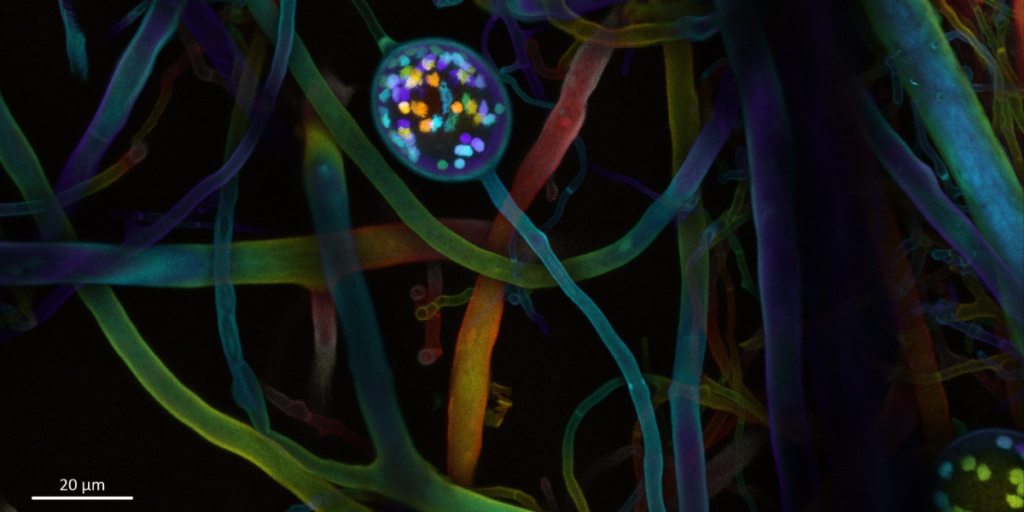
In comparison, Mycorrhizal fungi form a symbiotic relationship with plant roots, extending into a vast underground network of superfine hyphae they explore the soil beyond the reach of roots. In doing so, they access water and unavailable nutrient reserves, especially phosphorus through enzyme release — making better use of existing soil reserves and reducing the need for repeated fertiliser applications. Plants can acquire as much as 80% of their phosphorus from mycorrhizal fungi.[3]
Plant health and resilience is a major attribute. AMF presence enhances root structure and helps suppress soil-borne pathogens by occupying physical space, stimulating microbial competition and improving immune response. In compromised soil, excess copper, high sodium, root-knot nematode infestations, drought and even replant issues — mycorrhizal fungi have shown to help mitigate toxicity and support plant tolerance. By improving root growth, function and nutrient selectivity, these fungi can reduce the uptake of harmful elements and enhance plant resilience, providing promising biocontrol.[1,4]
Mycorrhizal fungi are the base of the food web, an ancient support system for much of life on earth. Playing a vital role in regulating the global carbon cycle, they are crucial for achieving net-zero emissions, with an estimated 13.12 gigaton of CO2 transferred from plants to fungi annually. This represents a massive carbon pool and the most effective carbon capture storage unit globally. [5]
Nutrients are exchanged for carbon-derived sugars produced by plants which are permanently transferred into the soil through the Glyco-protein AMF secrete, known as Mineral Associated Organic Carbon. Healthier root systems and improved soil structure further support this carbon storage function, offering a biological pathway to climate-resilient growing systems that work for farmers.
By bridging the gap between traditional ecological processes and modern farming systems, the use of Mycorrhizal fungi is backed by science, is crop-specific, and easy to apply. Reintegrating these symbiotic organisms, growers can adopt more sustainable practices — reducing input reliance while maintaining yield and quality.
It’s not about going backwards. It’s about moving forward, with biology on your team.
Sources:
1.Baum, W.El-Tohamy b, N Gruda – Increasing the productivity and product quality of vegetable crops using arbuscular mycorrhizal fungi: A review Scientia Horticulturae Volume 187, 13 May 2015
2.Lukas Schütz 1, 2, Andreas Gattinger 2, Matthias Meier 3, Adrian Müller 3, 4, Thomas Boller 1,Paul Mäder 2 and Natarajan Mathimaran1, 2*- Improving Crop Yield and Nutrient Use Efficiency via Biofertilization –A Global Meta-analysis Frontiers in Plant Science
3. Dr Vasilis Kokkoris (Fungal Ecologist) – How to encourage healthy mycorrhizal networks in your own soil – SPUN
4. X. Bing, Y Shengrui – Studies on replant problems of apple and peach – IV International symposium on Replant Problems
5. Heidi-Jayne Hawkins1,2,*, Rachael I.M. Cargill3,4, Michael E. Van Nuland 3,5, Stephen C. Hagen6, Katie J. Field7, Merlin Sheldrake3,5, Nadejda A. Soudzilovskaia8, and E. Toby Kiers3,5 – Mycorrhizal mycelium as a global carbon pool – National library of Medicine , current biology – 2023 Jun 5;33(11):R560-R573. Doi: 10.1016/j.cub.2023.02.027.


