
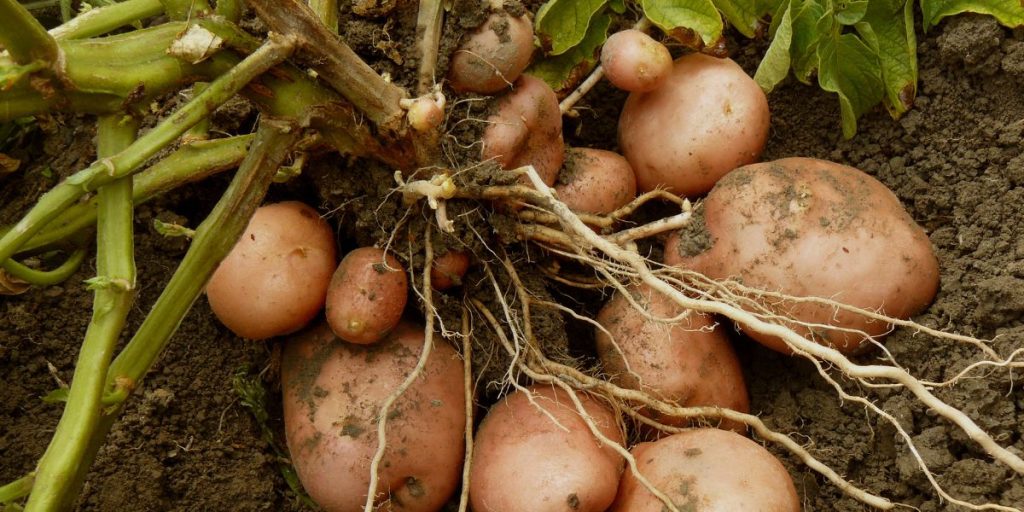
Here in Aotearoa, New Zealand, growing potatoes and onions is done on an enormous scale. New Zealand’s potato industry is worth $1.0 billion annually (according to Potatoes NZ) and our onion production adds approx. $160 million to the economy.
Most of the potatoes and onions grown are exported and so growers are focussed on high quality, disease free, high yielding crops which can be produced sustainably and in harmony with the environment.
Disease control is a major priority for growers across all fields of agriculture. Diseases like Peronospora sparsa (otherwise known as Downey mildew) is of particular interest when growing onions and, for potato growers, fungal diseases such as late blight and pink rot have the potential to devastate crops, and therefore profits. In this blog we offer some solutions for commercial growers growing potatoes and onions to get in front of disease issues while increasing yields and improving soil and plant health.
Rootella, Mycorrhizal Fungi for new plantings
Both potatoes and onions benefit from the associations with mycorrhizal fungi, onions in particular are highly mycorrhiza-dependent and can suffer in the absence of mycorrhizae. These beneficial organisms facilitate soil nutrient and water uptake by plants and can improve tolerance to some abiotic stresses such as frost, drought and salinity, as well as biotic stresses pertaining to certain soil-borne pathogens.
The addition of Mycorrhizal fungi, named Rootella, during seeding of a new crop will increase strike rate, reduce plant loss, and mycorrhizae act as a physical barrier to detrimental pathogens. Mycorrhizal fungi give plants better access to nutrients locked in the soil, especially Phosphorus, which is so important when growing potatoes and onions to ensure consistent growth and timely maturity. Phosphorus is one of the most difficult nutrients to supply as it is often ‘fixed’ and unavailable, with around 80% of applied phosphorus lost or leached annually. The ability of mycorrhizal fungi to scavenge for P can greatly reduce the need for excessive inputs of phosphorus – saving growers money and time.
The article below, on onions, published in the Scientific World Journal states quite clearly that Mycorrhizal fungi, plus beneficial organisms such as Trichoderma along with organic matter i.e. Humic/Fulvic acid, provides a synergistic biomass increase but also leads to improved nutritional quality. These natural products have great potential for sustainable environmentally friendly production systems in onions and other crops, which the world is leaning heavily towards.
In another study, a field experiment was carried out to determine the effects of the inoculation of onion (Allium cepa L.) with Glomus sp. Zac-19 on the development of onion white rot (Sclerotium cepivorum Berk.) and on onion production.
Mycorrhization delayed onion white rot epidemics by 2 weeks and provided a significant protection against the disease for 11 weeks after onion transplanting, as compared with non mycorrhizal controls. Mycorrhizal plants showed an increase of 22% in yield, regardless of the presence of the white rot pathogen.
Torres-Barragán, A., Zavaleta-Mejía, E., González-Chávez, C. et al. The use of arbuscular mycorrhizae to control onion white rot (Sclerotium cepivorum Berk.) under field conditions. Mycorrhiza 6, 253–257 (1996). https://doi.org/10.1007/s005720050133
Superzyme – Beneficial Organisms for disease resistance and soil health.
Superzyme is a bio-stimulant containing beneficial bacteria and fungi that help break down organic matter, releasing essential nutrients to the crop, improving dry matter growth and other crop quality parameters.
Superzyme contains two beneficial bacteria, Bacillus subtilis and Pseudomonas putida and two beneficial fungi, Trichoderma koningii and Trichoderma harzianum. In terms of disease pressure, these beneficial organisms utilise different mechanisms to provide protection from pathogens while improving soil structure and health. Investing in sustainable biological organisms not only reduces plant loss but also increases germination and yields, leading to long-term savings and greater profitability.
Superzyme in combination with Rootella, Mycorrhizal fungi, are powerful biological agents that improve nutrient uptake, and boost plant resilience in potato and onion crops, ensuring long-term health and productivity.
Mobilizer, Fulvic Acid, for Better Hydration and Mineral Uptake.
Mobilizer, Fulvic Acid, is a potent plant electrolyte engineered to improve plant photosynthesis and hydrate plants at a cellular level. When applied to the soil, Mobilizer significantly increases the mobility and availability of essential nutrients for enhanced production.
By mobilising nutrients and improving soil fertility, Mobiliser ensures that potato and onion crops receive the essential nourishment they require for optimal growth and resilience.
The use of Mobilizer with pre-emergent herbicides has a two-fold effect – the Mobilizer will literally ‘mobilise’ and increase the efficacy of the herbicide meaning less is needed to get the same results. In addition, Mobilizer will bind up toxins in the soil, reducing the harmful effects of leaching and damage to the soil microbiome.
Additional benefits include:
- Increasing crop yield and quality
- Reducing loss of minerals to leaching
- Enables plants to withstand periods of extreme conditions – heat and cold.
Products like Rootella, Mycorrhizal Fungi, Superzyme and Mobilizer work in synergy to ensure high quality yields while protecting your soil and the environment. Using biological solutions to mitigate disease pressure and reduce chemical inputs will ensure long term sustainability for your farm.
A recent trial showed that Mobilizer increased potato weights by 40%. Read the full report here.
Read the full Peracto trial here.


