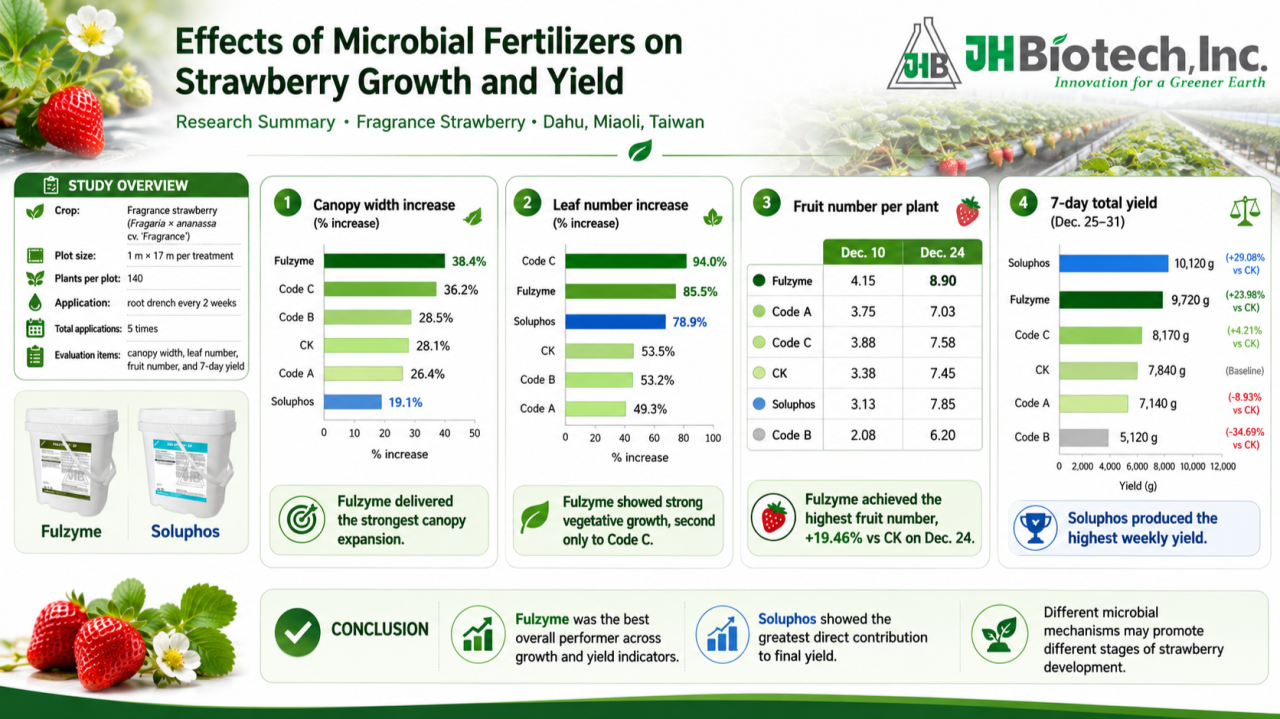
Overall, this study indicates that Fulzyme is highly suitable for promoting overall strawberry plant growth, canopy development, leaf formation, fruit number, and yield. For strawberry growers, Fulzyme may be positioned as a broad-spectrum growth and yield-supporting microbial product.
CT Feng Ph.D
Senior Researcher at IPAI & Plant Product Division Manager at JH Biotech, Inc.
May 15, 2026
Strawberry is a high-value crop that requires balanced nutrition, strong root activity, and healthy vegetative growth to support flowering, fruit setting, and final yield. In the study conducted in Dahu, Miaoli, Taiwan, microbial fertilizer treatments were evaluated on ‘Fragrance’ strawberry to compare their effects on canopy growth, leaf number, fruit number, and short-term yield. The results showed that Fulzyme-SP and Soluphos SP provided different but complementary benefits in strawberry production. Fulzyme demonstrated the strongest overall effect on plant growth and reproductive performance, while Soluphos showed the greatest contribution to final weekly yield.
Fulzyme SP performed particularly well in promoting vegetative growth. After five root-drench applications, Fulzyme increased strawberry canopy width from 19.46 cm per plant to 26.93 cm per plant, representing a 38.4% increase, the highest among all treatments. Canopy expansion is important in strawberry production because a larger and healthier canopy can support greater photosynthetic capacity, better carbohydrate accumulation, and stronger plant vigor. In commercial strawberry fields, improved canopy development may help plants establish faster after transplanting and better support fruit development during the reproductive stage.
Fulzyme also showed strong effects on leaf production. The number of leaves increased by 85.5%, ranking among the best treatments in the study. More leaves generally indicate improved vegetative growth and a larger photosynthetic surface area. This is especially important for strawberry because fruit development depends heavily on the plant’s ability to produce and transport carbohydrates. A higher leaf number may therefore contribute indirectly to better fruit filling, fruit size, and plant resilience under production stress. The study suggested that Fulzyme may improve the rhizosphere environment by promoting organic matter decomposition, nutrient release, and beneficial microbial activity, thereby strengthening overall plant growth.
In fruit production, Fulzyme also delivered clear advantages. On December 24, Fulzyme-treated plants produced 8.90 fruits per plant, compared with 7.45 fruits per plant in the untreated control. This represented a 19.46% increase over the control and was the highest fruit number among all treatments. In the 7-day yield evaluation from December 25 to 31, Fulzyme produced 9,720 g per plot, a 23.98% increase compared with the untreated control. These results indicate that Fulzyme is not only useful for vegetative growth but also contributes to fruit formation and yield improvement.
Soluphos SP showed a different pattern of benefit. Although its effect on canopy growth was lower than Fulzyme, it produced the highest total yield in the study. Soluphos achieved 10,120 g per plot during the 7-day harvest period, representing a 29.08% increase compared with the untreated control. This result suggests that Soluphos may be especially valuable during the reproductive and fruit-filling stages of strawberry production. As a phosphate-solubilizing microbial product, Soluphos may improve phosphorus availability in the root zone. Since phosphorus is closely associated with root development, flowering, energy transfer, and fruit development, improved phosphorus availability may directly support higher marketable yield.
Overall, the study indicates that Fulzyme is highly suitable for promoting overall strawberry plant growth, canopy development, leaf formation, fruit number, and yield, while Soluphos is particularly valuable for enhancing final yield through improved nutrient availability, especially phosphorus utilization. For strawberry growers, Fulzyme may be positioned as a broad-spectrum growth and yield-supporting microbial product, whereas Soluphos may be emphasized as a yield-focused microbial fertilizer. Used strategically, these two products may provide complementary benefits across different stages of strawberry production, from vegetative establishment to fruit development and harvest.
To learn more about the benefits of JH Biotech, Inc.’s biological products, please visit JHBIOTECH.COM or contact info@jhbiotech.com for additional technical information.